







RYAN DAVIS
RESEARCHER
YASH BALAJI
ENGINEER

ERIK SCHLUNTZ
SCIENTIST

SCROLL
We need bold innovators and inventive thinkers. We need daring revolutionaries and fearless dreamers. In short, we need STEM education—now more than ever.
STEM fields (science, technology, engineering, and math) are filled with problem solvers and mavericks, working tirelessly to make our world a better place. This is why the United States Marine Corps invests heavily in STEM education. Because the Marines recognize that when it comes to the future wellbeing of our country, the value of STEM cannot be overstated.
Every day, innovators in STEM are exploring new technologies, discovering cures to diseases, and inventing revolutionary technologies that will change the world as we know it. They are our link to the future, seeing the possibilities, connections, and patterns that will lead to incredible advances. They are the pioneers who spin fantasy into reality in order to create tangible change.
As our world continues to grow and change, we need warriors of STEM to fight for solutions to the challenges we face as citizens of the Earth. Their perseverance, bravery, and forward thinking are vital to that battle. This fighting spirit dovetails seamlessly with the values of the USMC. The Marines recognize that with every invention and discovery, every new idea and groundbreaking thought, we move towards something better—even if it means literally capturing lightning in a bottle.
In fact "lighting in a bottle" is exactly the cause that former Marine, Ryan Davis, has devoted his life to. He's following up his service to our country with service to the good of our planet.


Born in the lightning-dense Southeast, Ryan Davis grew up fascinated by electrical storms. As a child, he'd watch the Weather Channel the way some children watch cartoons. He was obsessed with trying to understand what was happening in the sky.
"I was able to observe electrical discharge at a very young age," he says, "it's something that stuck with me."
Davis was the kind of kid who was always looking for answers and yearned to explore—constantly on the search for a challenge. It's why he joined the United States Marine Corps at 18, because he heard that the Marines was the most challenging branch of the military.
"I knew I would be doing something good for my community by learning how to improve myself," he said of his choice. "I'd learn how to become more disciplined, more focused, and more of a contributing member to society."
It was a life-changing choice. The young man was stationed all over the world, and he not only learned about a diverse range of cultures, but he was able to explore different weather patterns. To this day, he's deeply grateful for the vast amount of knowledge he accrued in the Marines, along with the values that he says shaped his character.
"The things that I learned, the core values, honor, courage and commitment," he said, "those are the three things that I've tried to focus on even after the Marines. How can I be more courageous? How can I be more committed to being a person that was going to lookout for my fellow man?"
These values are what drove Davis to study renewable energy sources after his service. He believed he could be part of the solution to our global energy problem.
"I just wanted to continue to uphold the highest honor and tradition of the Corp and focus my efforts toward something that could benefit humanity and fully embody the core values."
Putting his childhood obsession with lightning to good use, Davis created First Light Consulting Incorporated, a company focused on astro-geo energy, hoping to harness the power of lightning and convert it into a renewable energy source.
"The average strike that takes place these days can power 56 homes for a single day," Davis explains. "And yet I've been told that the power of lightning was not significant at all."
Now, Davis is coming close to being able to direct the flow of energy from lightning and actually harness it. He hopes it will revolutionize the way we're able to store and collect energy, and believes that lightning will be powering homes and cars within 5 years. In 25 years, he'd like to be involved in space mining.
After gaining the discipline and determination to tackle any obstacle in the Marines, Davis believes that the sky is (quite literally) the limit. And like the flash of lightning against a dark, stormy sky, the future of energy looks bright.

A Marine in the field can often get stuck miles away from the nearest base or clean water source. These conditions can be dangerous and have caused Marines to have to waste precious space in their packs with water purifiers, filters, and tablets. They also have to burn precious time waiting for purifiers to work. This is a problem that STEM warrior Yash Balaji decided to tackle head on.
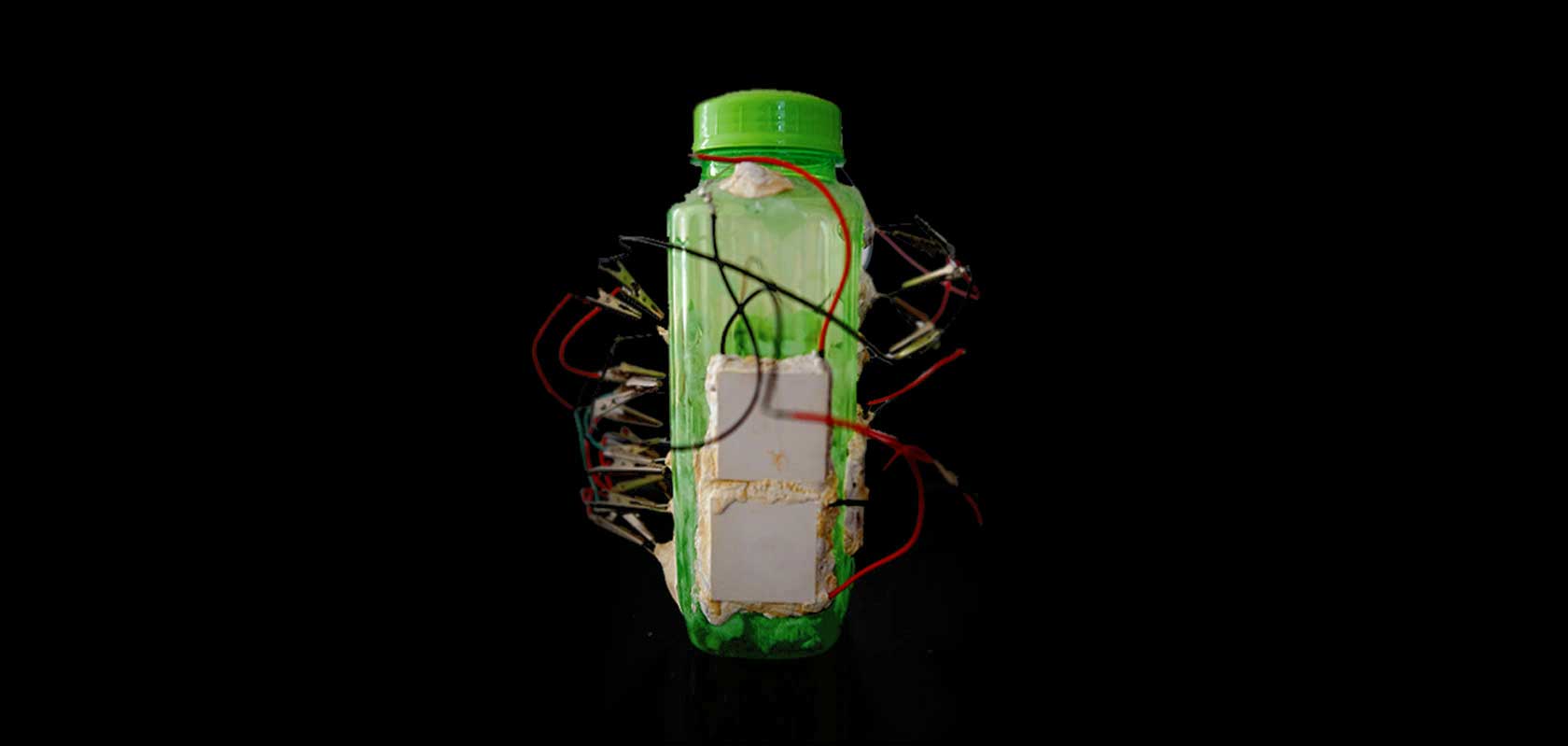
Balaji invented CleanBottle in 2014, as a way to purify and decontaminate water using only the heat of one's hands. The amazing device provides clean drinking water without the use of disposable filters or solar power, and it could streamline the way we help people access water—from natural disasters to war zones. Imagine being able to provide water bottles that clean the water easily.
"It's so simple to use," Balaji tell us. "You don't need any batteries. You don't need anything else. It's all just contained within one system."
CLEAN BOTTLE
Water purification is the process of removing undesirable chemicals, biological contaminants, suspended solids, and gases from contaminated water. Power from the electrical grid, a battery, a fuel cell, solar panels, or filters are currently required to purify water. In countries that lack access to filters and power, water purification is a serious concern.
Raised mostly in New Jersey, Balaji was born in India. During his travels back home with his family, he noticed that many people had to walk miles to get access to clean water.
"There's a big struggle to get water for a lot of people," Balaji says. "It's the most basic necessity for life. Even if you don't have food, you can still survive for weeks. But if you don't have water, you'll die within a few days."
The problem felt personal, and Balaji wanted to help. His answer was, CleanBottle. The device slips over any water bottle and harnesses the Seebeck Effect, using thermoelectric generator tiles to power the purification process.
It's pretty simple to hear Balaji explain it:
"On one side of the tile, it's relatively hot from your hand contacting the tile. The other side is relatively cold and that temperature differential will create an electric current. I use that to power an ultraviolet c-light and the ultraviolet light is what purifies the water by killing microorganisms."
It's a revolutionary idea and one that has the potential to change millions of lives. As an innovator in STEM, Balaji sees this world as a precious resource, and feels that it's his calling to help make it run better.
"I'm going to be living in this world for the next 70, 80, 90 years," he says. "I want it to be a world that I want to live in."
Balaji's invention will provide an easy, affordable method for cleaning drinking water. That's the kind of innovation that makes a real difference. For Marines on the field, having this quick, lightweight solution will free up time to keep our country secure. It's a shining example of STEM at its best.

Imagine a robot taking over security detail at an office, or helping Marines as they field scout locations. With the guidance of human pilots, the value of these AI would be enormous. Robots have the potential to make our lives significantly easier and, more importantly, safer. And while these ideas may seem far-fetched, they're already a reality at Cobalt Robotics.
Cobalt Robotics made the news recently with the announcement that they're ready to put security robots into the workplace. Much like self-driving cars, these new robots are equipped with highly sensitive technology, which allows them to interact with their surroundings in an intelligent way.
"We have more than 60 sensors total, from cameras," says Erik Schluntz, the co-founder of Cobalt, "thermal cameras, microphone array, laser scanners... all these different tools that the robot can use to see the world around it. Plus, we have a high end super computer in every single robot to process all that information."
For now, the main job of Cobalt Robotics robots will be to patrol office buildings and look for situations that are out of the ordinary. And while they are highly equipped to react to any unusual stimuli, Schluntz and his co-founder, Travis Deyle, are quick to point out that the robots aren't meant to replace human personnel. When a robot finds a person who isn't supposed to be in a certain location, it will Skype in a human, who will then take control of the robot and talk to the intruder. Rather than replacing a flesh and blood person, the robot will simply enhance the human's abilities and scope.
"The robot is a tool for a very capable human security guard," Deyle says. "With Cobalt, that guard can project their presence throughout the entire organization by controlling 20 or 30 of these robots. And then when it detects something, that person can actually provide high level, human-level intelligence and respond."
It's tech that you may prove incredibly useful for Marines abroad too. Robots might patrol a large base with human aides on the ready to jump in when needed. This would actually make bases safer and more secure, without risking human life.
The Cobalt team wanted to make sure that people would respond positively to the help, rather than be fearful of the futuristic technology. As Deyle points out, most of the time even if someone is in the office at 3am, it's much more likely that it's simply an employee who forgot a computer than a thief.
"You want the robot to welcome them and say, 'Hey, how can I help you?' and 'Touch your badge,'" Schulntz says, "rather than be intimidating or scary."
Deyle and Schluntz eventually see the robots as being able to perform many tasks around the office and testing so far has revealed that employees are excited about this prospect.
"We want (our robots) to help facilities do inspections and maintenance, figure out what needs to be brought to their attention, and act as virtual receptionists," Schulntz says, enthusiastically.
Cobalt is about to begin deploying their robots into real companies. Schluntz and Deyle are thrilled, but they've still got their eyes on the future. They predict that great advances are coming in all areas of science and technology.
"For me, it goes back to Arthur C. Clarke and his famous saying, 'Any sufficiently advanced technology would seem like magic,'" Deyle says. "I love living in a world where I can walk around and just everything seems like magic all the time."
Flexible and Automatic Security
Cobalt builds indoor robots for security, designed to work alongside human guards to provide better security than people can do alone. The robots have the sensing, computation, and intelligence of an autonomous car meant to keep offices safe by patrolling the premises, looking for intruders or anything that's out of the ordinary -- while also providing a friendly face to office employees.
CONCLUSION
STEM research and advances are of utmost importance in our world. Without a doubt, the warriors in these fields—creating new technology and finding innovative solutions to problems—are heroes. Whether they're helping to make water drinkable in developing nations, engineering robots that will make our workplaces safer, or trying to capture energy from lightning, these visionaries are using their unique skills and talents to make our world a better place. The fighting spirit of the Marines continues to inspire STEM warrior, Ryan Davis to battle through any obstacle. Similarly, Yash Balaji and the team at Cobalt Robotics fight past challenges to create new technologies that will surely prove life-changing.
As Travis Deyle of Cobalt Robotics said, fields in STEM can almost seem like magic. Their advances are often so revolutionary that to the common person they seem dazzlingly impossible. But, he said, even when you're like him and you can look under the hood and understand the mechanics behind new technologies or innovations, it doesn't make the work any less thrilling. It's always awe-inspiring what the warriors of STEM can accomplish.
"We're in a period of amazing technological advancement," Deyle says. "It's not just robotics either. It's in biology. It's in chemistry, in materials science, rocketry. There are so many amazing things going on that I hope they get life extension technology because I want to see where it's all going."